




N.E. Fehri, R. Belabbas, S. Agradi, A. Quattrone, D. Vigo, Gabriele Brecchia,
L. Menchetti, O. Barbato, E. Angelucci, Sebastiana Failla, et al.
![]() To cite this version:
To cite this version:
N.E. Fehri, R. Belabbas, S. Agradi, A. Quattrone, D. Vigo, et al.. Impact of dietary enrichment with omega-3 polyunsaturated fatty acids from extruded linseed and algae on the growth performance of rabbits. 13th World Rabbit Congress, IRTA, ASESCU, Oct 2024, Tarragone, Spain. hal-04735390
HAL Id: hal-04735390
https://hal.science/hal-04735390v1
Submitted on 14 Oct 2024
HAL is a multi-disciplinary open access archive for the deposit and dissemination of sci- entific research documents, whether they are pub- lished or not. The documents may come from teaching and research institutions in France or abroad, or from public or private research centers.
L’archive ouverte pluridisciplinaire HAL, est destinée au dépôt et à la diffusion de documents scientifiques de niveau recherche, publiés ou non, émanant des établissements d’enseignement et de recherche français ou étrangers, des laboratoires publics ou privés.
IMPACT OF DIETARY ENRICHMENT WITH OMEGA-3 POLYUNSATURATED FATTY ACIDS FROM EXTRUDED LINSEED AND ALGAE ON THE GROWTH PERFORMANCE OF RABBITS
Fehri N.E.1, Belabbas R.2, Agradi S.1, Quattrone A.1, Vigo D.1, Brecchia G.1*, Menchetti L.3, Barbato O.4, Angelucci E.5, Failla S.6, Faustini M.1, Abdel Kafy S.7, Jemmali B.8, Ben Salem I.9, Savietto D.10, Colin M.11, Guillevic M.12, Ozuni E.13, Or E.14, Castrica M.15, Curone G.1.
1Dept. of Veterinary Medicine and Animal Sciences, University of Milan, Via dell’Università 6, 26900, Lodi,
Italy
2Laboratory of Biotechnologies Related to Animal Reproduction, Institute of Veterinary Sciences, University Blida, B.P 270, Road of Soumaa, Blida 09000, Algeria.
3School of Bioscience and Veterinary Medicine, University of Camerino, Via Circonvallazione 93/95, 62024
Matelica, Italy
4Dept. of Veterinary Medicine, University of Perugia, Via San Costanzo 4, 06126, Perugia, Italy
5Dept. of Agricultural, Environmental and Food Science, University of Perugia, Borgo XX Giugno 74,
06124, Perugia, Italy
6Research Centre for Animal Production and Aquaculture (CREA), Via Salaria 31,00015,Monterotondo, Rome, Italy
7Animal Production Research Institute, Agriculture Research Center, Dokki 12651-Giza, Egypt
8Higher School of Agriculture, University of Carthage, Mateur – LR13AGR02, Tunisia.
9Dept. Productions Animales, Service de Zootechnie et Economie Agricole, ENMV, 2020 Sidi Thabet, Université de la Manouba, Tunisia
10GenPhySE, INRAE, Université de Toulouse, ENVT, 31326 Castanet-Tolosan, France
11COPRI Sarl, Coat Izella 2, 29830, Ploudalmezeau, France
12Valorex, BP 60138, 35301, Fougères CEDEX, France
13Dept. of Public Heatlh, Agricultural University of Tirana Rr “Pajsi Vodica”, Kodër-Kamëz, 1029 Tirana,
Albania
14Istanbul Unıversity Cerrahpasa, Faculty of Veterinary Medicine:7, 34320 Avcılar/İstanbul, Turkey
15BCA, University of Padova, Viale dell’Università 16, 35020, Legnaro, Italy
*Corresponding author: gabriele.brecchia@unimi.it
ABSTRACT
Currently, the use of n-3 polyunsaurated fatty acids (n-3 PUFA) in rabbits’ nutrition represents an interesting strategy not only to enhance the productive and reproductive performances, but also the nutritional value of the meat, potentially creating a functional food for humans. This study investigated the effects of n-3 PUFA dietary integration with extruded linseed alone and in combination with algae Padina pavonica extract on the growth performance and metabolic status of fattening rabbits. Sixty New Zealand White growing rabbits, from weaning (35 days of age) until slaughter (85 days of age), were divided into three different groups (n=20) and fed different pelleted diets: commercial diet (CNT group), commercial diet integrated with 5% extruded linseed (L5% group), and commercial diet integrated with 3.5% extruded linseed in combination with 0.2% algae Padina pavonica extract (LPP group). In order to evaluate the growth performances of the rabbits, live weight (LW), average daily gain (ADG), and feed conversion ratio (FCR) were measured weekly, while feed intake was monitored daily. Moreover, to evaluate the metabolic status of the animals, plasma concentrations of insulin as well as glucose and non-esterified fatty acids (NEFA) were evaluated at 35, 60, and 85 days of age. In terms of productive performance, the fattening rabbits in the L5% group exhibited the highest marginal mean for LW, associated to higher average ADG and lower average FCR (for all: P<0.05), suggesting that the use of linseed alone improved feed efficiency compared to the LPP group. Furthermore, the integration with both extruded linseed and algae Padina pavonica extract did not significantly alter plasma concentrations of insulin, glucose, or NEFA, indicating no negative impact on the animals’ energy metabolism.
Key words: Live weight, insulin, fattening rabbit, metabolites, NEFA.
INTRODUCTION
In rabbit farming, the productive performance of fattening rabbits is associated with different parameters related to the health status, growth rate, and metabolic efficiency of the animals. Optimizing the growth performances in fattening rabbits represents a key factor in increasing the rabbit farmers’ profitability, especially considering the high feeding costs. Moreover, a well- balanced diet is crucial for these animals to meet their energy requirements and prevent nutrient deficiencies. Currently, the use of n-3 polyunsaurated fatty acids (n-3 PUFA) in animal nutrition appears an interesting strategy to enhance the rabbits’ productive and reproductive performance. In addition, reaserch suggests that supplementing rabbits’ feed with n-3 PUFA offers a promising strategy to enhance the nutritional value of rabbit meat, potentially creating a functional food with benefits for human health (Dalle Zotte and Szendrő, 2011). Both plant and animal products rich in n-3 PUFA have been explored in the rabbits’ nutrition, although most studies have focused on linseed-derived products which gave the most interesting results (Dal Bosco et al., 2004). Among potential sources of plant-derived n-3 PUFA, marine algae have gained significant interest due to their established beneficial effects and their environmental sustainability (Al-Soufi et al., 2022). Notably, our study is the first to investigate the use of the brown algae Padina pavonica in rabbit diets to evaluate its effect on fattening rabbits. In this context, the objectives of this study were to investigate the impact of the integration with extruded linseed alone and in combination with algae Padina pavonica extract on the growth performance and energy metabolism of fattening rabbits.
MATERIALS AND METHODS
Animals, diets, and experimental design
Sixty male New Zealand White rabbits were individually housed in conventional cages (L×W×H: 75×38×25 cm) under controlled environmental conditions, in a commercial farm located in Central Italy. The experimental protocol was approved by the Ethical Committee of the Department of Veterinary Medicine of the University of Milano (OPBA_18_2021). At weaning (35 days of age), the rabbits were randomly divided in three experimental groups (n
= 20 animals/group), each receiving a different pelleted diet. The experimental diets were formulated in accordance with current nutritional recommendations for fattening rabbits, ensuring they contained similar proximate chemical composition. The three diets were formulated as follows: a control diet consisting of commercial feed (CNT), the same commercial feed with adjusted ingredient proportions and the substitution of 5% extruded linseed (L5%), and commercial feed with the adjustment of ingredient proportions and the substitution of 3.5% extruded linseed combined with 0.2% algae Padina pavonica extract (LPP). The proximate chemical composition of the diets, as detailed in Table 1, was determined following the AOAC methods (2016). The animals were slaughtered at 85 days of age. Throughout the study (35 to 85 days of age), the rabbits received a daily ration gradually increasing from 100 g/day to 160 g/day. Fresh water was always available. The rabbits’ live weight (LW), the agerage daily gain (ADG), and feed conversion ratio (FCR) were recorded weekly, whereas the individual feed intake (FI) was daily monitored.
Table 1: Chemical composition of the experimental diets.
| g per 100 g of dry matter | Experimental diets1 | ||
| CNT | L5% | LPP | |
| Dry matter | 89.34 | 89.49 | 89.94 |
| Crude protein | 15.23 | 15.28 | 15.23 |
| Total fat | 3.56 | 3.75 | 3.57 |
| Starch | 12.07 | 12.07 | 11.87 |
1CNT: Commercial control diet; L5%: CNT diet integrated with 5% of extruded linseed; LPP: CNT diet integrated with 3.5% extruded linseed and 0.2% Padina pavonica extract.
Plasma hormones and metabolites
Blood samples were taken at 35, 60, and 85 days of age from the ear marginal vein. The samples were immediately centrifuged at 3500 rpm for 15 minutes, then plasma and serum were stored until the assay. From each sample, insulin, glucose, and non-esterified fatty acids (NEFA) were analysed as previously described by Menchetti et al., 2018.
Statistical Analysis
The productive performance were analyzed using the Linear Mixed model including days as repeated factor, with a first-order autoregressive covariance structure. The procedures of Generalized Estimating Equations were used to analyze insulin and metabolites concentrations using Normal distribution and Identity link function or gamma distribution and log link. The models evaluated the main effects of time, group, and the interaction between group and time. Correlations were evaluated using Spearman’s coefficient (ρ). Statistical analyses were performed with SPSS Statistics version 25 (IBM, SPSS Inc., Chicago, IL, USA). We defined P<0.05 as significant.
RESULTS AND DISCUSSION
Productive parameters
Studies conducted so far have found little influence of n-3 PUFA on the productive performance of fattening rabbits, independently from the source, wether linseed or marine algae (Matics et al., 2017). In our study, the L5% group showed the highest marginal mean for LW, compared to both CNT and LPP groups (P<0.05, data not shown). Notably, no significant differences in LW were observed between the CNT and LPP groups. Furthermore, ADG and FCR were significantly affected by the different diet (P<0.01). Indeed, rabbits fed the L5% diet exhibited higher marginal means for ADG (41.0±1 g per day) and lower for FCR (4.1±0.2) compared to those fed the LPP diet. These findings suggest that incorporating 5% extruded linseed into the diet might improve growth performance and feed efficiency compared to a combination of linseed and algae. Thorughout the entire experimental trial, no differences in FI were found among groups (data not shown). This is an interesting outcome, particularly given that several previous studies have raised concerns about feed palatability when integrating various marine algae into rabbits’ diets at 2% (Okab et al., 2013). It’s important to note that our study represents the first experimental trial to employ the alga Padina pavonica, distinct from the seaweeds documented in existing literature and incorporated in the diets at 0.2%.
Hormones and metabolites
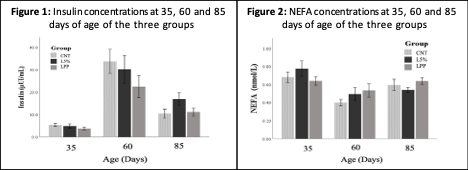
The LPP group had the lowest marginal means for insulin concentrations (12.4±1.0, 13.5±1.4, and 9.8±0.9 µIU/mL for CTN, L5%, and LPP, respectively; Figure 1; P=0.048), although pairwise comparisons did not reveal statistically significant differences between groups. Scientific literature suggest that marine algae contain different bioactive compounds, including
high levels of soluble dietary fibers, which may reduce glycaemia and insulin levels by slowing down both nutrients’ intestinal absorption and hormonal response through their capacity to increase the viscosity in the digestive tract (Vaugelade et al., 2000). Circulating NEFA are important metabolic energy sources which change in response to the energy status of the animals. In our study, NEFA concentrations were influenced by time and, regardless of group, the lowest values were found at 60 days (P=0.001; Figure 2). NEFA concentrations were also influenced by group x time interaction (P=0.01), but multiple comparisons did not highlight differences among groups. The absence of significant differences in NEFA concentrations among groups suggest that diets integrated with linseed and algae do not impair energy metabolism, as evidenced by the same level of lipolysis compared to the CNT group. Notably, a negative correlation was observed between NEFA and insulin concentrations (ρ=-0.401, P<0.001). This finding aligns with one of the established roles of insulin as an anti-lipolytic hormone, suppressing the release of NEFA from the adipose tissue into circulation.
Finally, glucose concentrations were only affected by age, with the highest values observed at 35 days (110.7±6.1 mg/dL; P<0.001), whereas neither group (P=0.985) nor its interaction with time (P=0.597) had significant effects on glucose levels. The observed peak in glucose levels at weaning is consistent with known age-related changes in insulin sensitivity and glucose metabolism of young animals. The lack of significant differences in glucose levels among groups suggests that neither 5% extruded linseed nor 0.2% alga Padina pavonica had a negative impact on glucose metabolism.
CONCLUSIONS
Overall, the results suggest that both extruded linseed and algae Padina pavonica extract can be safely incorporated into rabbit diets at 5% and 0.2% respectively without compromising the productive performance and the energy metabolism of the animals.
ACKNOWLEDGEMENTS
This research was funded by the PRIMA project ORABBIT. The authors acknowledge the collabation of Giovanni Migni, Azienda Agricola Brachino Patrizia, and Borgo Faeta of Gianni Fontana.
REFERENCES
Al-Soufi S., García J., Muíños, A., López-Alonso, M. 2022. Marine Macroalgae in Rabbit Nutrition-A Valuable Feed in Sustainable Farming. Animals., 12, 2346.
Association of Official Analytical Chemist (AOAC). 2016. Official Methods of Analysis (20th ed.). Gaithersburg, MD, USA: AOAC, n.d.
Dal Bosco A., Castellini C., Bianchi L., Mugnai C., 2004. Effect of dietary α-linolenic acid and vitamin E on the fatty acid composition, storage stability and sensory traits of rabbit meat. Meat Sci. 66, 407– 413.
Dalle Zotte A., Szendrő Z., 2011. The role of rabbit meat as functional food. Meat Sci. 88, 319–331.
Matics Zs., Cullere, M., Szín, M., Gerencsér, Zs., Szabó, A., Fébel, H., Odermatt, M., Radnai, I., Dalle Zotte, A., Szendrő, Zs., 2017. Effect of a dietary supplementation with linseed oil and selenium to growing rabbits on their productive performances, carcass traits and fresh and cooked meat quality. J. Anim. Physiol. Anim. Nutr. 101, 685–693.
Menchetti L., Canali C., Castellini C., Boiti C., Brecchia G., 2018. The different effects of linseed and fish oil supplemented diets on insulin sensitivity of rabbit does during pregnancy. Res. Vet. Sci. 118, 126–133.
Okab A.B., Samara E.M., Abdoun K.A., Rafay J., Ondruska L., Parkanyi V., Pivko J., Ayoub M.A., Al-Haidary A.A., Aljumaah R.S., Peter M., Lukac N., 2013. Effects of dietary seaweed (Ulva lactuca ) supplementation on the reproductive performance of buck and doe rabbits. J. Appl. Anim. Res. 41, 347–355.
Vaugelade P., Hoebler, C., Bernard, F., Guillon, F., Lahaye, M., Duee, P.-H., Darcy-Vrillon, B., 2000. Non-starch polysaccharides extracted from seaweed can modulate intestinal absorption of glucose andinsulin response in the pig.